
Why “Boredom” Isn’t Always Boredom
After eight years as a certified dog trainer and veterinary assistant, I’ve worked hands-on with hundreds of dogs: high-energy herding breeds, stubborn terriers, and anxious shelter rescues. I’ve learned that the question “How do I keep my dog busy?” is usually the wrong one.
The better question is “What does this particular dog need to feel safe, interested, and in control?” The answer looks completely different from dog to dog. Three dogs taught me that lesson: a restless Australian Shepherd mix, a shut-down Beagle mix, and a Labrador whose “boredom” wasn’t boredom at all.
Max: The Elite Athlete in the Waiting Room
Max was a two-year-old Australian Shepherd mix I fostered. He had been surrendered from a quiet apartment because his owners didn’t have time for him. They thought he was “hyperactive” and needed less stimulation so he wouldn’t get hyped up. In reality, he was an elite athlete sitting in a waiting room 23 hours a day.
When he arrived, he showed classic signs of severe under-stimulation:
- Pacing the perimeter of the living room, whining softly and tracking every shadow and sound outside, even after a long walk
- Systematically shredding cardboard boxes, mail, and the foam inserts of dog beds if left alone for even ten minutes
- Nipping at my ankles and pant hems in the evening, trying to herd me into moving
Max wasn’t a bad dog. He was desperately underemployed. Even two-hour hikes didn’t touch his restlessness. They built his stamina while his brain stayed starved.
What Finally Worked
I shifted his routine from physical exhaustion to mental engagement and instinctual work.
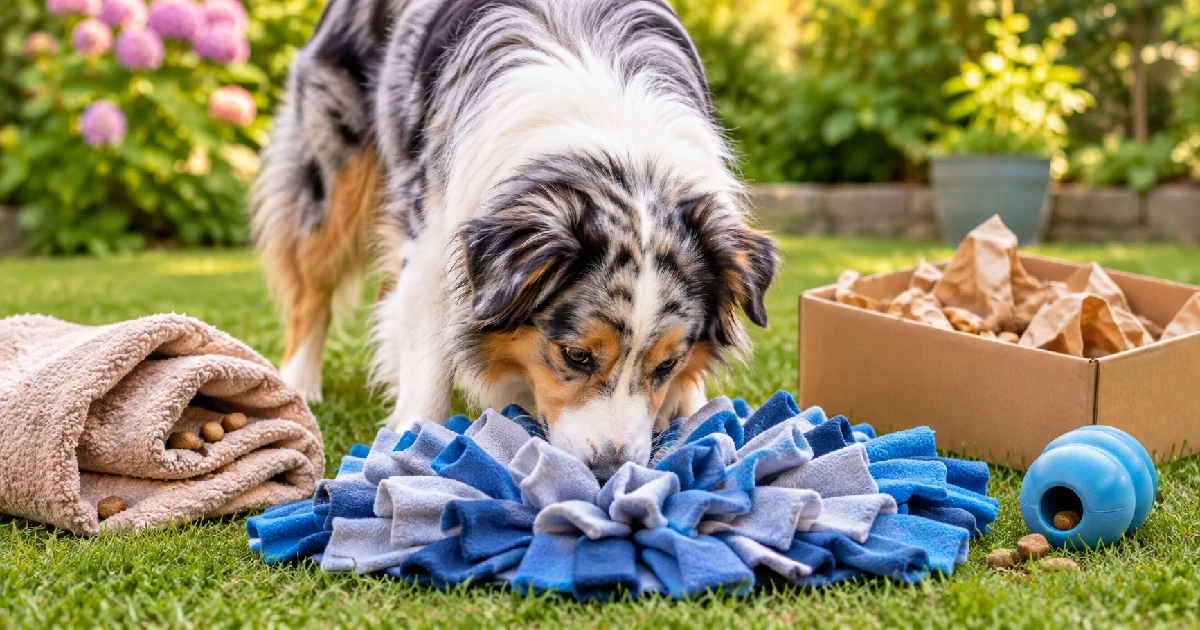
First, I stopped feeding him from a bowl. Every meal became a problem-solving exercise using snuffle mats, rolled-up towel puzzles, and frozen Toppls packed with his regular kibble, a little broth, and mashed pumpkin. Mealtime went from a 30-second gulp to a 25-minute mental workout. These were simple and purposeful, built into his regular meals rather than piled on top of them.
Second, I gave him a daily job. Every afternoon I hid high-value treats around the house or yard and released him with a “Find it!” cue. Watching a stressed dog drop his head, lock onto a scent trail, and let out a deep sigh when he finds the treat is something special. Nose work burns an enormous amount of mental energy.
How Fast Did It Work?
The first shift came quickly, but a true “off switch” took longer.
- Days 1 to 3: After his first 25-minute session with a frozen Toppl and a towel puzzle, Max lay down with his chin on his paws. He was still alert and watching me, but his body finally stayed in one place.
- Days 4 to 7: The frantic, demanding energy faded. The evening ankle-nipping stopped completely because he was looking forward to his afternoon scent game instead of inventing his own entertainment.
- Weeks 2 to 3: He stopped scanning the windows at every passing sound and began choosing to nap in the middle of the day without being crated or managed.
What Backfired With Max
Some of my best lessons came from what failed. For a high-drive dog, a few popular “enrichment” ideas pushed him further into over-arousal.
Hard Plastic Treat Balls
I assumed a moving object would tap into his herding instincts. Instead, because the kibble didn’t fall out every time he nudged it, his frustration tolerance snapped within two minutes. He demand-barked at the ball, slammed it against the baseboards, and lunged at it. He ended up panting, wild-eyed, and more wound up than before. That toy was retired permanently.
Complex Puzzle Boards
I tried a wooden board with sliders, levers, and hidden compartments, assuming a smart dog would enjoy the challenge. But Max had zero patience for fine-motor work while over-stimulated. He tried to flip the whole board over, then chewed on the pegs out of impatience. We shelved it until his baseline calm improved, and even then he preferred sniffing to mechanical puzzles.
Lick Mats (Too Early)
Lick mats are famous for calming dogs, but in his first week Max licked one three times, heard a car door slam, and walked away. His nervous system was too revved up for a stationary, low-arousal activity. It was like asking someone mid-panic attack to sit down and do a crossword puzzle. Lick mats became a great bedtime tool later, once nose work and foraging had lowered his stress.
Rapid-Fire Obedience Drills
Before I understood the difference between obedience and enrichment, I ran 15-minute sessions of “sit, down, spin, paw, touch, heel.” Max memorized the sequence and started throwing behaviors at me before I asked, whining and hopping in place for the treat. Micromanaged drills kept him in high-arousal performance mode instead of letting his brain slow down and work independently.
Automatic Ball Launchers
A friend lent me a ball launcher so Max could wear himself out. Within five minutes he was staring motionless at the chute with dilated pupils, trembling, and ignoring his name. Repetitive motion flooded him with adrenaline and dopamine with no satisfying conclusion, and healthy play turned into compulsive fixation.
The Pattern Behind the Failures
For Max, anything involving fast movement, loud clattering, or mechanical friction tipped him into over-arousal. Quiet, stationary, nose-driven tasks, where the reward came steadily as long as he kept sniffing, were what unlocked his calm side.
Clover: The Opposite Problem
If Max was a Ferrari with no brakes, Clover was the exact opposite. She was an eight-year-old Beagle mix with severe shelter shutdown and sensory sensitivity, and she came to me as a medical foster after six months in a noisy municipal kennel. She didn’t pace, bark, or shred anything. She curled into a tight ball in the corner of her crate, trembled whenever a floorboard creaked, and refused to eat if anyone was watching.
With Max, enrichment was about burning off excess mental energy and giving a busy brain a job. With Clover, it had to build confidence, autonomy, and psychological safety without overwhelming her nervous system.
Zero Pressure and Complete Choice
Big, open scent searches worked for Max. For Clover, a wide-open room felt terrifyingly exposed. If I tossed treats across the floor, she wouldn’t touch them.
What worked was micro-enrichment inside her safe zone. I placed a small, flat snuffle mat in the open doorway of her crate, or laid a crumpled piece of butcher paper with three pieces of kibble next to her bed. She could engage without leaving her safe base, and she could quit the moment she felt overwhelmed.
High Success and Zero Frustration
Clover had no confidence. If a puzzle required pushing a heavy lid or flipping a flap, she assumed she had made a mistake, tucked her tail, and retreated. So I built in instant, effortless wins: an open egg carton with kibble sitting right in the cups, or smelly treats scattered in a shallow box of loose fleece scraps. Every nose-poke paid off immediately, teaching her that exploring led to safe, predictable rewards.
How Clover Changed
Her progress wasn’t a sudden breakthrough. It came in inches over weeks.
- Weeks 1 to 2: She only engaged when the door was closed and she was alone. The first sign of progress was hearing the faint rustle of butcher paper from the hallway and finding the snuffle mat cleaned out when I came back.
- Weeks 3 to 4: She began creeping a few feet outside her crate to forage on a yoga mat I laid down as a runway. I angled my body away and read quietly while she worked.
- Weeks 5 to 6: Her tucked tail loosened into a gentle, low wag when I walked in with her snuffle mat. She started nudging my hand to ask me to put it down.
The Moment She Turned a Corner
Around week four, I was on the couch reading with my feet tucked up. I had placed a shallow cardboard box of crumpled packing paper and a few pieces of roasted chicken about six feet from her crate, in the middle of the living room rug.
She stood at the edge of her crate for a full two minutes, nose twitching, torn between caution and the smell of warm chicken. Then she stepped out into the open room, buried her head in the packing paper, and started snuffling loudly. When a piece of chicken rolled toward my feet, she didn’t bolt. She paused, glanced up at my face, gave one tentative tail thump, trotted over to grab it within inches of my shoes, and went right back to the box.
That was the shift from surviving by hiding to choosing curiosity while I was right there in the room.
How to Know When to Make It Harder
With a fearful dog, pushing too fast can erase two weeks of trust in two seconds. I used a body-language green-light checklist before increasing difficulty by even a small notch:
- Loose body posture while working: If her ears were pinned back, her weight was shifted toward the exit, or she grabbed food and darted back to her crate to eat it, the setup was still too hard. I only leveled up when she had relaxed shoulders, soft eyes, and ate right where she found the food.
- Speed and confidence on the current level: When she cleared an open egg carton or flat snuffle mat within 60 seconds without pausing to scan the room, the task had become effortless, and she was ready for a tiny layer of friction.
When Boredom Is Actually Pain
One of the clearest lessons from my time in the clinic involved a six-year-old Labrador whose owners requested a behavioral referral. Over three months he had started pacing at night, obsessively licking his front paws, and shredding his bedding when left alone. They assumed he was under-stimulated, so they bought harder chews and a weighted vest and started taking him on longer runs. His behavior got worse.
During his physical exam, he flinched hard when the vet palpated his lumbar spine and hips, then turned his head to lip-lick. Radiographs confirmed early, moderate bilateral hip dysplasia and lower back inflammation.
He wasn’t bored. He was self-soothing chronic orthopedic pain. Pacing kept his stiff joints from locking up, and repetitive licking helped dull the ache. The well-intentioned enrichment, including longer runs and hard toys that made him brace his shoulders and back while gnawing, was hurting him. Once we started pain management and switched him to stationary, low-impact nose work on soft mats, the destructive behavior disappeared within two weeks.
Any sudden onset of pacing, destructive chewing, or obsessive licking, especially in a middle-aged or senior dog, is a medical symptom until proven otherwise. You cannot enrich your way out of untreated pain, GI discomfort, or cognitive dysfunction.
What the Enrichment Industry Gets Wrong
The modern enrichment industry has turned something simple and biological into an aesthetic, consumer-driven obstacle course. Here is my honest take.
“A Tired Dog Is a Good Dog” Is a Trap
When people hear “tired dog,” they picture endless fetch, five-mile runs, or dog park free-for-alls. That builds an endurance athlete with an overstimulated nervous system. You aren’t creating a calm dog, just raising their stamina while flooding their brain with stress hormones. A truly fulfilled dog isn’t exhausted. They’re satisfied. Five minutes of quiet, low-arousal sniffing does more for emotional regulation than forty-five minutes of frantic ball-chasing.
Instagram Enrichment Over-Complicates and Over-Feeds
Social media is full of multi-layered frozen toys packed with quail eggs, goat milk, freeze-dried minnows, and berries. That creates two problems:
- Caloric overload: Many owners add a big surplus of high-fat toppers on top of full meals, leading to preventable weight gain, which is far worse for a dog’s long-term health than mild boredom.
- Humans entertaining themselves: Elaborate spreads are mostly fun for the owner to assemble. Your dog doesn’t care about aesthetic layering. Scattering regular kibble across the grass or rolling it in an old towel taps the same ancestral foraging drive in ten seconds with no extra calories.
The frozen Toppls I made for Max were different. They used his regular kibble, a little broth, and pumpkin, and they were part of his daily food allowance, not an extra.
Frustration Is Not Mental Stimulation
Hard, noisy rolling balls and complicated sliders often don’t enrich dogs. They frustrate them. A dog pawing frantically, whining, panting, or slamming a toy against the wall isn’t doing healthy brain work. Good enrichment should leave a dog’s body softer, their breathing slower, and their focus grounded. If a puzzle leaves a dog wide-eyed and wired, it’s working against you.
A 10-Minute Daily Plan on a Tiny Budget
If you only have ten minutes and a small budget, you don’t need fancy equipment or a subscription box. The most powerful enrichment is free.
Scatter Feeding (5 Minutes)
Scatter your dog’s regular kibble, or a portion of it, across a lawn, a patch of grass, or a clean, uncarpeted room. Your dog has to lower their head, use their nose, and hunt for every piece. Mealtime turns from a 30-second gulp into a calming foraging session.
The Afternoon Reset (5 Minutes)
Lay an old bath towel flat, sprinkle a handful of treats across it, and roll it up loosely like a sleeping bag. Or toss a few pieces of food into an empty shipping box and fold the flaps loosely. These tasks offer a little problem-solving without much frustration, and they satisfy the urge to shred and manipulate objects.
A safety note: towel rolls and box shredding are only for dogs who shred and spit out what they tear, and always supervise. Dogs who swallow fabric or wet cardboard can end up with serious obstructions.
What to Skip
- Expensive complex puzzle boards. They take time to set up and wash, and they often frustrate dogs. Your dog can’t tell the difference between a $50 slider puzzle and a cardboard shoebox with crumpled paper.
- Instagram-worthy food prep. You don’t need goat’s milk, chia seeds, or multi-ingredient frozen creations. Regular kibble, water, or a spoonful of plain yogurt is plenty. Always check labels for xylitol, which is toxic to dogs and can appear in peanut butter and some yogurts.
Safety Blind Spots Owners Overlook
In a clinic, we don’t just ask whether something keeps a dog busy. We ask whether it will end up in an operating room, an ER, or a metabolic workup. Here are the blind spots I see most.
Intestinal Blockages
Foreign body obstructions are heartbreakingly common, and many start as well-meaning enrichment.
- Towels and plush toys: Ingested strips of terrycloth or stuffing can cause linear foreign bodies, which are more dangerous than a swallowed ball because the fabric bunches up the intestines like an accordion and can cut through tissue.
- Cardboard and paper: Shredding is fine for dogs who spit it out. Dogs who swallow wet wads can develop severe impaction.
Chews That Break Teeth
We see slab fractures of the upper fourth premolars every week, usually from antlers, marrow bones, and yak chews. Use the thumbnail test: if you can’t dent it with your thumbnail, it’s too hard for your dog’s teeth.
Strain in Senior, Arthritic, and Flat-Faced Dogs
- Slippery floors and rolling toys: An arthritic senior scrambling on hardwood after a treat ball is an ACL tear or back injury waiting to happen. Anchor puzzles on a non-slip mat or rug.
- Narrow, deep toys for flat-faced breeds: French Bulldogs and Pugs can have their airflow restricted when pushing their faces into narrow rubber toys, leading to panic or overheating. Wide, shallow lick mats and flat snuffle mats are much safer.
- Neck strain: Bending down to the floor for 20 minutes can bother a senior dog with cervical spine issues. Raise a lick mat onto a low step or attach it to a wall at shoulder height.
Calorie Overload
Treats, toppers, and stuffed toys all count toward your dog’s daily intake. Reduce their regular meals to account for them, or use their meals as the enrichment.
Set the Guilt Down
If you remember one thing from this post, let it be this: enrichment is not about keeping your dog busy. It’s about helping your dog feel safe, autonomous, and understood.
So many loving owners carry quiet guilt. They scroll past color-coded puzzle toys and intricate frozen molds and feel like they’re failing because they worked a nine-hour shift, it’s raining, and dinner went into a regular ceramic bowl. Please set that guilt down. Your dog has no idea what a $45 puzzle board is, and they aren’t grading your creativity.
What your dog craves is agency: the freedom to use the senses they were born with and make a few choices in a world where humans control almost everything about their day.
- When you pause on a walk so your dog can spend two minutes reading the scent trail on a tree trunk instead of tugging them along to hit your step goal, that is enrichment.
- When you scatter their regular kibble across the living room rug on a busy Tuesday evening so they can hunt for supper, that is enrichment.
- When you notice your senior dog is stiff and swap a slippery floor toy for a warm, quiet lick mat on a soft rug, that is enrichment.
The goal was never to turn your living room into a canine amusement park or to exhaust your dog into silence. It’s to look at the specific dog in front of you, whether a restless working mix like Max, a cautious shelter soul like Clover, or an aging companion whose body is slowing down, and ask: what makes the world feel a little more interesting and a little safer for you today?
This post is based on my experience and is not a substitute for veterinary advice. If your dog shows a sudden change in behavior, or if you have a senior dog or a dog with health concerns, check with your own vet before starting a new enrichment routine.

Daniel Williams is a dog trainer and Austin, Texas enthusiast with a deep appreciation for the city he calls home. A lifelong admirer of Austin’s vibrant culture, welcoming community, and laid-back lifestyle, he enjoys exploring the city and everything it has to offer.
Outside of writing and dog training, Daniel is a passionate soccer fan who loves playing the game, spending time with friends, and getting lost in a good book. Whether he’s enjoying a casual soccer match, discovering something new through reading, or catching up with friends, he appreciates the simple things that make life enjoyable.
At DogBrainGames.com, Daniel writes about dog brain games, mental enrichment, interactive activities, and creative ways to keep dogs mentally engaged. He enjoys sharing practical ideas that encourage curiosity, problem-solving, and stronger bonds between dogs and their owners.